
;)
Clinical development teams globally are increasingly exploring multi-pathway combination regimens to overcome the efficacy limitations of monotherapy in inflammatory bowel disease (IBD). In ulcerative colitis and Crohn’s disease, combining therapies/molecules with complementary mechanisms has emerged as a promising strategy to improve clinical outcomes (Talar-Wojnarowska et al., 2024; Yan et al., 2025).
However, realizing the potential of combination treatment regimens requires an integrated development approach that addresses trial design, long-term safety, co-formulation strategy, and cross-company governance from the outset.
Trial design
Building this development roadmap starts with trial design, where regulatory rules for proving each drug’s individual contribution drive study size and cost (Cummings et al., 2025; Talar-Wojnarowska et al., 2024). Regulatory agencies require empirical proof demonstrating what each pathway adds to the combination regimen, which leads to larger and longer clinical programs (Cummings et al., 2025; U.S. Food and Drug Administration, 2013). For example, evaluating combination therapy in moderate to severe active ulcerative colitis requires randomized head-to-head trial designs that compare the dual regimen directly against each individual monotherapy (Talar-Wojnarowska et al., 2024).
Running these comparative studies is demanding when adding an unapproved investigational drug to an approved IBD backbone, and the complexity increases when combining two unapproved assets without established monotherapy baselines. Sponsors must structure early-phase IBD studies to confirm each component’s therapeutic contribution before funding large pivotal trials.
Long-term safety
Beyond isolating efficacy across comparator arms, IBD trial protocols must manage the safety risks of suppressing two immune pathways simultaneously. Combining dual biologics or small molecules creates overlapping systemic and mucosal immunosuppression. This increases regulatory scrutiny around infection and long-term tolerability.
Regulatory authorities therefore require expanded long-term safety datasets and active pharmacovigilance to evaluate the benefit-risk profile in chronic populations (McCormack et al., 2023; U.S. Food and Drug Administration, 2013). Embedding extended safety follow-up directly into early protocols ensures teams capture the longitudinal data needed for regulatory approval.
Co-formulation strategy
Alongside designing protocols for efficacy and safety, clinical strategy teams must resolve technical CMC hurdles to develop a co-formulated product. Delivering two active therapies in a single presentation, where technically and clinically appropriate, can simplify dosing and support lifecycle value.
However, the CMC challenges vary by modality. For injectable biologic combinations, key considerations include: molecular compatibility, protein stability, aggregation, high-concentration viscosity, container-closure integrity, and delivery-device performance. For oral small-molecule fixed-dose combinations, the principal challenges include: API–API and API–excipient compatibility, dose and formulation constraints, dissolution, bioavailability, pharmacokinetic compatibility, and manufacturing consistency.
These risks may arise when combining approved therapies and can intensify when one or both investigational candidates have limited formulation, stability, or manufacturing data. Aligning formulation feasibility with early clinical milestones helps teams address manufacturing bottlenecks before pivotal trials begin (Bokemeyer et al., 2023).
Executing these decisions requires structured governance when the individual IBD assets belong to different companies. Cross-company programs require partners to align early on the intellectual property, trial data ownership, governance structures, shared pharmacovigilance duties, and clinical drug supply (Cummings et al., 2025). Without upfront alignment, operational friction across any of these areas can stall trial execution.
Cross-company governance
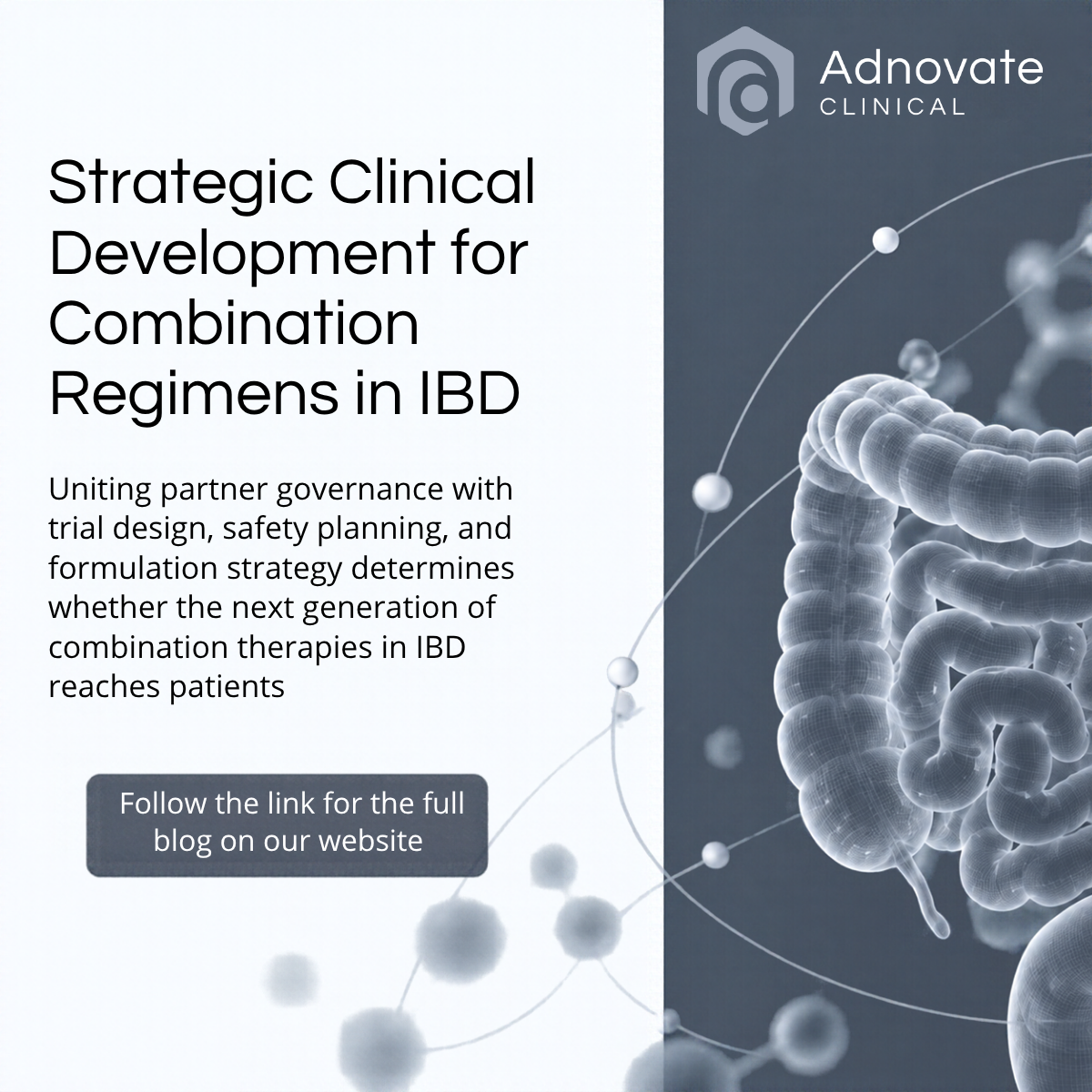
Uniting partner governance with trial design, safety planning, and formulation strategy determines whether the next generation of combination therapies in IBD reaches patients. Identifying an attractive partner initiates the process, but a coordinated and preferably collaborative execution across functions will drive combination treatment to regulatory approval. Sponsors must simultaneously prove individual component contribution, manage long-term safety, select a viable delivery format, and maintain alignment across development partners.
Organizations that integrate these four elements into a single clinical development roadmap will increase the probability of success to advance combination regimens from early trials to approved care.
Planning a combination programme? Contact Adnovate Clinical Here
References
Yan, J.-W., Nie, M., Zhang, H., Liu, Y.-M., & Tang, F.-S. (2025). Strengths, weaknesses, opportunities, and threats analysis of combination therapy for inflammatory bowel disease. World Journal of Gastroenterology, 31, 100607. https://pubmed.ncbi.nlm.nih.gov/40061596/ (Last accessed on November 10, 2026).
Cummings, J., Gold, M., Mintun, M., Irizarry, M., von Eschenbach, A., Hendrix, S., Berry, D., Sampaio, C., Sink, K., Landen, J., Kivipelto, M., Grundman, M., Arnold, S. E., Green, A., Partrick, K., Nisenbaum, L., Burstein, A., & Fillit, H. (2025). Key considerations for combination therapy in Alzheimer’s clinical trials: Perspectives from an expert advisory board convened by the Alzheimer’s drug discovery foundation. The Journal of Prevention of Alzheimer’s Disease, 12, 100001. https://pubmed.ncbi.nlm.nih.gov/39800453/ (Last accessed on November 09, 2026).
U.S. Food and Drug Administration. (2013, June). Codevelopment of two or more new investigational drugs for use in combination: Guidance for industry. U.S. Department of Health and Human Services. https://www.fda.gov/media/80100/download (Last accessed on November 10, 2026).
Talar-Wojnarowska, R., Fabisiak, A., Zatorski, H., Płoszka, K., Błaziak, K., Fendler, W., Rydzewska, G., Małecka-Wojciesko, E., & Eder, P. (2024). Comparison of ustekinumab, infliximab and combination therapy in moderately to severely active ulcerative colitis – a study protocol of a randomized, multicenter, head-to-head COMBO-UC trial. Frontiers in Medicine, 11. https://doi.org/10.3389/fmed.2024.1458998 (Last accessed on November 09, 2026).
McCormack, M. D., Wahedna, N. A., Aldulaimi, D., & Hawker, P. (2023). Emerging role of dual biologic therapy for the treatment of inflammatory bowel disease. World Journal of Clinical Cases, 11, 2621-2630. https://doi.org/10.12998/wjcc.v11.i12.2621 (Last accessed on November 10, 2026).
Bokemeyer, B., Hlavaty, T., Allez, M., Selema, P., Moosavi, S., Cadatal, M. J., Fowler, H., Mueller, M., Liau, K. F., & Gisbert, J. P. (2023). Real-world observational cohort study of treatment patterns and safety outcomes of infliximab biosimilar CT-P13 for the treatment of inflammatory bowel disease (CONNECT-IBD). Expert Opinion on Biological Therapy, 23, 791-800. https://doi.org/10.1080/14712598.2023.2200883 (Last accessed on November 09, 2026).